China Top 10 Outdoor Solar Street Light Manufacturers
China Top 10 Outdoor Solar Street Light Manufacturers is designed for buyers comparing suppliers, technologies, and long-term project value. China remains a major production hub for integrated solar lighting systems. Its factories offer LED fixtures, lithium batteries, intelligent controllers, and customized poles. Yet product quality differs widely.
A reliable comparison should examine more than purchase price. It should assess photovoltaic efficiency, battery chemistry, lumen output, operating hours, waterproof ratings, and control systems. Field experience matters too. A lamp that shines brightly in a showroom may perform poorly after several cloudy days. Ask for test reports, installation references, warranty terms, and replacement-part support. Check the details.
Energy-efficiency expert Amory Lovins stated, “The cheapest energy is the energy you don’t use.” This principle fits Solar Street Lights Outdoor projects. Efficient LEDs and accurate motion controls can reduce battery size and improve nighttime reliability. However, energy savings depend on real conditions, including shade, dust, temperature, traffic, and maintenance practices. A perfect specification sheet cannot replace a site survey.
This guide introduces ten Chinese manufacturers through a practical lens. It considers product design, manufacturing capability, customization, certifications, delivery experience, and after-sales service. Some companies may excel in municipal projects, while others suit highways, campuses, villages, or commercial spaces. Rankings are never permanent. Prices change. Technologies improve. Buyers should verify current data directly before signing contracts. That final step is easy to overlook.
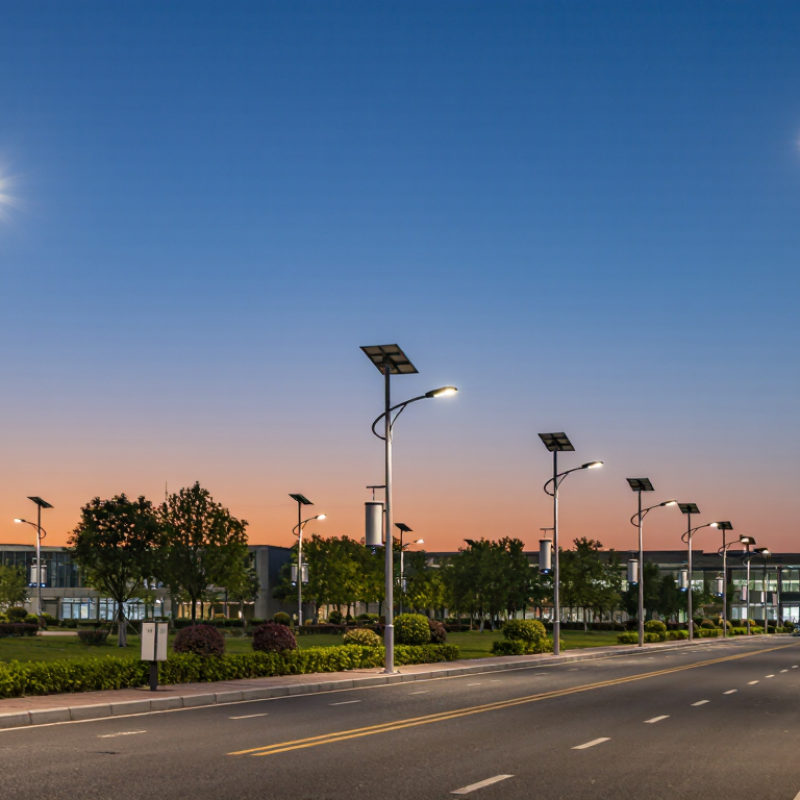
China’s Outdoor Solar Street-Light Market: 2024 Capacity and Growth Data
China’s outdoor solar street-light market expanded in 2024, supported by municipal upgrades, rural infrastructure, and export demand. Industry estimates suggest annual production capacity reached several million complete systems, although reporting methods differ between manufacturers. Some factories measure only finished lamps. Others include panels, batteries, controllers, and poles.
The strongest production clusters continued to offer integrated assembly, battery testing, lighting simulations, and outdoor durability checks. Export-oriented suppliers also increased capacity for high-lumen roads, parks, ports, and remote communities. Demand growth appeared steady rather than explosive, with many market observers estimating a high-single-digit annual increase in 2024. These figures need caution. Capacity does not equal confirmed sales, and idle production lines can distort the picture.
Tips: Compare tested output, battery chemistry, operating hours, and warranty records. Ask for independent reports covering salt spray, water resistance, thermal cycling, and photovoltaic performance. A factory visit can reveal practical details, such as panel storage, soldering quality, and battery traceability. Do not judge suppliers by catalog size alone. A cheaper unit may require earlier battery replacement, especially in cloudy regions. Procurement teams should also check local installation conditions and seasonal sunlight data before selecting the top ten candidates.
China’s Outdoor Solar Street-Light Market: 2024 Capacity and Growth Data
China’s national solar photovoltaic installed capacity reached approximately 887 GW by the end of 2024, adding about 277 GW during the year. The 45.5% year-on-year increase indicates a rapidly expanding solar-energy supply chain that supports the development and deployment of outdoor solar street-light systems. National solar PV capacity is used here as an official market-growth proxy because standalone outdoor solar street-light capacity is not separately reported in national statistics.
Source: National Energy Administration of China; capacity figures are rounded to the nearest 0.1 GW.
Solar Street-Light Technology: 150+ lm/W LEDs, LiFePO₄, and IP65
China’s top 10 outdoor solar street-light manufacturers are increasingly judged by measurable performance, not polished catalogs. A claimed output above 150 lm/W can reduce panel and battery size, but it may describe the LED chip, not the complete lamp. Ask for system-level photometric data at the selected current and temperature. In field checks, real efficiency often drops because of optics, driver losses, dust, and heat.
LiFePO₄ batteries
LiFePO₄ batteries remain a practical choice for outdoor lighting. They offer strong cycle life, stable chemistry, and better thermal behavior than many older battery types. However, capacity changes in cold weather. A dependable supplier should provide battery test records, operating-temperature limits, and protection settings for overcharge and deep discharge. The controller matters as much as the cell.
IP65 protection means dust-tight construction and resistance to water jets. It does not guarantee safe operation after flooding or careless cable installation. Inspect the gasket, cable gland, breather valve, and drainage path. Small details matter. During project evaluations, lux readings should be taken beneath the pole and between poles, after several cloudy days. This exposes weak autonomy claims. Solar simulations are useful, but local shade, winter rain, and battery aging can disagree with the spreadsheet. I would also question any quotation that hides LED current, battery usable capacity, or warranty conditions. Performance claims need context.
Profiles of China’s Top 10 Manufacturers: Products, Scale, and Markets
China’s top ten outdoor solar street-light manufacturers show a broad product range. Their catalogs commonly include all-in-one lamps, split systems, smart controllers, lithium batteries, and galvanized steel poles. Many offer 20W to 150W LED fixtures for rural roads, parks, ports, campuses, and industrial zones. Some provide motion sensors and remote monitoring. Others focus on simpler units for cost-sensitive projects.
Scale differs sharply across the group. Large factories often combine LED assembly, battery testing, pole production, and export departments. Smaller specialists may outsource poles but customize lighting controls. According to IRENA’s Renewable Capacity Statistics 2024, global solar capacity reached about 1,419 GW by the end of 2023. This expanding base supports demand for off-grid lighting, but it does not prove every supplier has equal engineering quality.
The IEA PVPS Trends 2024 report also confirms China’s dominant position in global photovoltaic manufacturing and deployment.
Markets extend across Southeast Asia, Africa, the Middle East, Latin America, and remote domestic areas. Export capability usually depends on IEC testing, battery safety documentation, weather protection ratings, and reliable after-sales support. Public company data remains uneven. Rankings can reflect export volume rather than audited revenue. That is a weakness. Buyers should inspect lumen maintenance, battery-cycle records, sample installations, and warranty terms. Factory visits help, but even visits cannot replace independent testing. Performance claims need evidence.
Comparing the Top 10: 5–12 m Poles, Autonomy, Warranty, and ROI
China Top 10 Outdoor Solar Street Light Manufacturers
Comparing China’s top ten outdoor solar street light manufacturers requires more than checking lumen claims. For 5–12 m poles, review beam distribution, wind-load calculations, battery chemistry, and controller quality. A 5 m road may need lower output, while a 12 m pole demands stronger optics and careful spacing. In field assessments, cloudy weeks expose weak designs quickly. Eight hours of rated autonomy may become four after aging, dust, and winter temperatures.
Tips:
Request a complete test file. Check battery capacity at working temperature, not only laboratory conditions. Confirm whether the warranty covers batteries, controllers, LEDs, and pole coatings separately. A five-year warranty sounds useful, but replacement shipping and labor may remain your responsibility.
ROI depends on delivered light, not catalogue brightness. Compare purchase cost, installation hours, battery replacement cycles, and annual maintenance. A reliable system can reduce trenching and grid charges, but poor spacing creates dark patches and costly corrections. Ask manufacturers to provide a photometric layout for each pole height. Also inspect sample units before a large order. I have seen attractive proposals fail because connectors loosened after heavy rain. That detail is easy to miss. Manufacturers with documented factory testing, traceable components, and responsive technical support usually offer safer long-term value, even when their initial quotation is not the lowest.